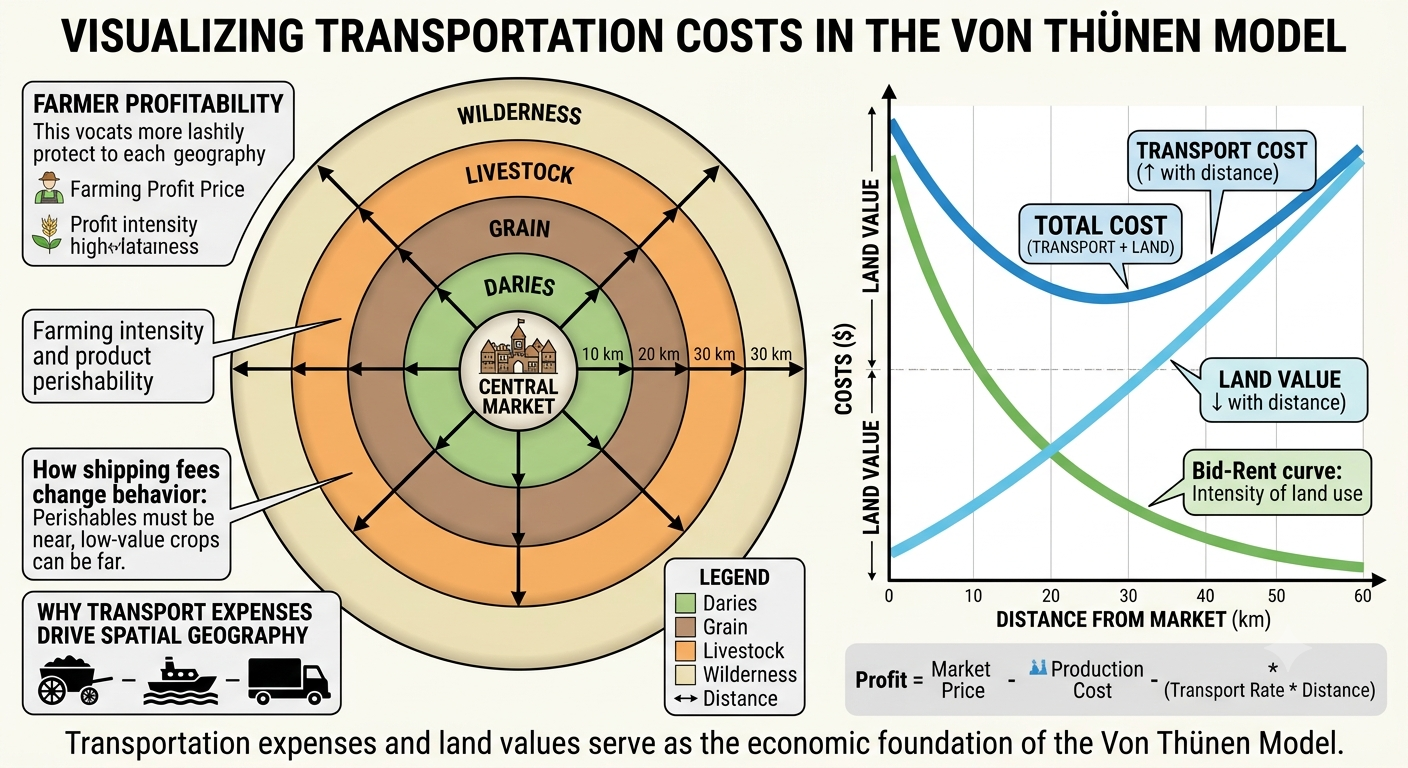
Understanding why certain crops are grown near cities while others are cultivated farther away has long been an important question in geography and economics. Farmers must decide what to grow, where to grow it, and how to transport it to consumers while balancing production costs and profits. One of the earliest and most influential theories developed to explain these decisions is the Von Thünen Model.
Although modern agriculture is shaped by technology, global trade, refrigeration, and improved transportation, the Von Thünen Model remains a cornerstone of human geography. It helps students understand how transportation costs, land value, and market access influence agricultural land use.
If you’ve searched for Von Thünen Model, you may be preparing for an AP Human Geography exam, studying economics, or simply curious about one of the most important theories in agricultural geography. This comprehensive guide explains the model in simple language while exploring its assumptions, land-use zones, strengths, weaknesses, and modern relevance.
What Is the Von Thünen Model?
The Von Thünen Model is a theory of agricultural land use developed by the German economist Johann Heinrich von Thünen in 1826.
The model explains how farmers choose which agricultural products to produce based primarily on their distance from a central market. According to the theory, transportation costs play a major role in determining where different types of farming take place.
The basic idea is straightforward:
- Land closest to the marketplace tends to be the most valuable because of its location.
- Transportation costs increase with distance.
- Farmers grow products that are expensive to transport near the market.
- Products that are cheaper to transport are grown farther away.
The Von Thünen Model demonstrates that profit is influenced not only by production costs but also by the cost of getting goods to consumers.
Who Developed the Von Thünen Model?
The Von Thünen Model was created by Johann Heinrich von Thünen, a German landowner, economist, and agricultural researcher.
Through years of observing farming practices and analyzing production costs, von Thünen noticed that transportation expenses significantly affected farming decisions.
His work became one of the earliest mathematical explanations of agricultural land use and later influenced both geography and economics.
Today, the Von Thünen Model is studied in schools and universities around the world because it introduced the idea that location itself has economic value.
Why Was the Von Thünen Model Created?
Before the nineteenth century, there was little formal explanation for why different farming activities occurred in different locations, leading von Thünen to formalize the first spatial economic framework in location theory
through his 1826 treatise, The Isolated State.
Von Thünen wanted to understand questions such as:
- Why are dairy farms often located near cities?
- Why are forests sometimes found closer to markets than grain farms?
- Why are large-scale grain farms often farther away from urban centers?
- How do transportation costs affect agricultural profits?
The Von Thünen Model attempted to answer these questions by combining geography with economics.
The Main Idea Behind the Von Thünen Model
At the heart of the Von Thünen Model is a simple economic principle.
Farmers aim to maximize profit.
Profit depends on several factors:
- Selling price.
- Cost of production.
- Transportation expenses.
- Distance to the market.
- Land value.
As transportation costs increase with distance, farmers choose crops that provide the greatest return after these costs are deducted.
The closer the farm is to the market, the higher the land value tends to be because access to consumers is easier and transportation costs are lower.
The Assumptions of the Von Thünen Model
To simplify real-world conditions, the Von Thünen Model makes several assumptions.
These assumptions create an ideal situation that allows the theory to focus on transportation costs.
The assumptions include:
- One isolated city serves as the only market.
- The surrounding land is completely flat.
- Soil fertility is the same everywhere.
- Farmers have equal access to technology.
- There are no rivers, mountains, or natural barriers.
- Transportation occurs equally in every direction.
- Farmers seek to maximize profit.
- There are no government regulations affecting agriculture.
These assumptions are not realistic in every situation, but they make it easier to understand the model’s basic concepts.
The Four Agricultural Rings of the Von Thünen Model
According to the Von Thünen Model, agricultural land is divided into concentric zones that surround a central market. Each ring represents a different type of agricultural activity based on transportation costs and land value.
First Ring: Dairy Farming and Market Gardening
The land closest to the city is reserved for products that are highly perishable or expensive to transport.
Examples include:
- Fresh vegetables.
- Fruits.
- Milk.
- Eggs.
- Flowers.
These products spoil quickly and require frequent deliveries, making locations close to the market more profitable despite higher land prices.
Second Ring: Forests
When von Thünen developed his model, wood was an essential source of fuel and construction material.
Because wood is bulky and expensive to transport, forests were placed relatively close to the city.
Today, this ring is often interpreted historically since modern transportation and alternative energy sources have reduced the importance of fuelwood.
Third Ring: Field Crops
The third ring contains crops that are less perishable and easier to transport.
Examples include:
- Wheat.
- Corn.
- Barley.
- Oats.
These crops can be stored for longer periods, allowing farmers to grow them farther from the market without suffering major losses.
Fourth Ring: Livestock Ranching
The outermost ring is used primarily for livestock grazing.
Animals can walk to market or be transported relatively efficiently compared with highly perishable products.
Because ranching requires large areas of land, locating it farther from expensive urban land makes economic sense.
Why Distance Matters in the Von Thünen Model
Distance is the foundation of the Von Thünen Model.
As farms become farther from the market:
- Transportation costs rise.
- Delivery times increase.
- Profit margins may decrease.
- Land prices generally fall.
Farmers must balance lower land costs against higher transportation expenses when deciding what to produce.
Transportation Costs and Profit
One of the greatest contributions of the Von Thünen Model is demonstrating that transportation costs directly influence land use.
A crop that is profitable close to the market may become unprofitable if grown many miles away because shipping costs consume much of the potential profit.
Likewise, products that are inexpensive to transport can remain profitable even when grown at greater distances.
Real-World Examples of the Von Thünen Model
Although the Von Thünen Model was developed nearly two centuries ago, its core ideas can still be observed in many parts of the world. Modern transportation, refrigeration, and international trade have changed farming significantly, but distance from markets continues to influence agricultural decisions.
For instance, in and around large cities, it may be feasible to operate large fruit, vegetable, leaf,berry, and dairy farms. Because such products typically don’t store long, they may be transported to the cities’ food stores on a same-day basis. This closeness keeps the products fresher and reduces their transport costs to customers.
In zones farther away from large cities, farmers typically grow grains such as wheat, corn, soybeans and rice that can last many weeks or even several months before the product needs to be marketed.
As distance increases, immediate shipping becomes less critical, a commercial dynamic frequently analyzed on Primium Business when evaluating supply chains and regional market expansion. They could be raising large amounts of beef, chicken, or other livestock-typically because the land is available at much lower prices for raising livestock near large, distant markets than land farther out to pasture the animals near, and bring, livestock to market. All of the examples show transportation/distance matter, albeit a much more complex system than the original Von Thnen Model!
Why the Von Thünen Model Was Important
Before the Von Thünen Model, there was no widely accepted economic explanation for agricultural land-use patterns.
Johann Heinrich von Thünen introduced several groundbreaking ideas that continue to influence geography and economics today.
His model showed that:
- Distance affects farming decisions.
- Transportation costs influence profitability.
- Land close to markets has greater economic value.
- Farmers make production choices based on maximizing returns.
- Geography and economics are closely connected.
These concepts later influenced urban planning, regional economics, and location theory.
Advantages of the Von Thünen Model
Although modern agriculture is far more advanced than it was in the early nineteenth century, the Von Thünen Model offers several important advantages.
It Is Easy to Understand
The model explains economic concepts through simple principles that students can readily understand.
The concentric rings clearly demonstrate how transportation costs can influence agricultural patterns.
It Connects Geography and Economics
One of the greatest strengths of the Von Thünen Model is its ability to combine physical location with economic decision-making.
It explains that farming is influenced not only by soil and climate but also by profitability.
It Provides a Foundation for Modern Location Theory
Many later economic and geographic models expanded upon von Thünen’s original ideas.
His work helped establish the field of location economics, which studies how the placement of businesses and industries affects costs and profits.
It Encourages Analytical Thinking
The model helps students understand why farmers growing different products may choose different locations, even within the same region.
Limitations of the Von Thünen Model
Despite its historical significance, the Von Thünen Model has several limitations because it is based on highly simplified assumptions.
It Assumes a Single Market
In reality, most regions have multiple towns and cities where agricultural products can be sold.
Farmers often choose among several markets depending on prices and demand.
It Assumes Uniform Land
The model assumes that all land has identical soil quality and climate.
Actual farming areas differ greatly in:
- Soil fertility.
- Rainfall.
- Elevation.
- Temperature.
- Water availability.
These factors strongly influence what crops can be grown.
It Ignores Modern Transportation
When the Von Thünen Model was created, transportation relied on horses and wagons.
Today, highways, refrigerated trucks, railways, cargo ships, and air transportation allow food to travel long distances quickly and efficiently.
As a result, fresh produce can often be imported from other countries rather than being grown near cities.
It Does Not Consider Government Policies
Modern agriculture is influenced by:
- Subsidies.
- Import and export regulations.
- Environmental laws.
- Trade agreements.
- Tax policies.
These factors can affect farming decisions just as much as transportation costs.
Technology Has Changed Agriculture
Advances in farming technology have transformed food production.
Improved irrigation systems, greenhouse farming, refrigeration, and precision agriculture allow crops to be grown successfully in locations that would not fit the original Von Thünen Model.
The Von Thünen Model and Modern Agriculture
Although today’s farming systems are much more complex, many of the model’s ideas remain relevant.
For example:
- Greenhouses are commonly located close to urban areas so fresh vegetables can be produced year-round.
- Dairy farms frequently remain relatively close to processing plants because milk requires timely transportation.
- Large grain-producing regions continue to take advantage of lower land costs farther from urban centers.
- Farmers still compare transportation expenses with land prices when making business decisions.
Instead of replacing the Von Thünen Model, modern agriculture has expanded upon it by incorporating new technologies and global markets.
Why Students Still Study the Von Thünen Model
The Von Thünen Model is widely taught in geography, economics, and environmental science courses because it introduces several important concepts.
Students learn:
- How transportation influences economic activity.
- Why different agricultural products are grown in different locations.
- How land value changes with distance from markets.
- How scientific and economic models simplify complex real-world situations.
The model is also a common topic in AP Human Geography and introductory university courses because it provides a strong foundation for understanding agricultural geography.
Common Misconceptions About the Von Thünen Model
Myth 1: The model perfectly describes modern farming.
Not true. The Von Thünen Model is a simplified theoretical model rather than an exact representation of today’s agricultural systems.
Myth 2: Transportation costs no longer matter.
Modern transportation has reduced costs, but transportation expenses still influence profitability, especially for perishable products.
Myth 3: Every city follows the same ring pattern.
Real-world geography rarely produces perfect circles because mountains, rivers, highways, climate, and urban development all affect land use.
Myth 4: The model is outdated and useless.
Although some assumptions no longer reflect modern agriculture, the Von Thünen Model remains valuable for understanding the relationship between location, transportation, and economic decision-making.
The Lasting Legacy of the Von Thünen Model
Few geographic theories have had as much influence as the Von Thünen Model.
Its lasting contributions include:
- Introducing location theory to economics.
- Demonstrating the relationship between transportation costs and land use.
- Providing a framework for studying agricultural geography.
- Inspiring later models in urban planning and regional development.
Even though agriculture has evolved dramatically since 1826, the principles introduced by Johann Heinrich von Thünen continue to shape discussions about land use and economic geography.
Conclusion
Widely cited as one of the leading explanations in agricultural geography and economics is the Von Thnen Model. The theory was formulated by Johann Heinrich von Thnen and explains how transportation costs, land prices, and the distances from a market center affects farming. The model explains why perishable products are generally grown closer to the city than some other less perishable crops and livestock by establishing patterns of agricultural activity in concentric rings outward from a city center.
While it does have simplified assumptions and doesn’t exactly account for modern agriculture, the basic ideas presented in the model are not completely irrelevant. Due to the impact of transportation, technology, and worldwide trade of agricultural goods, modern farming methods differ greatly from those in von Thnen’s day, however transportation costs and agricultural Although farming has evolved, land prices remain an important consideration when planning agricultural activities.
Frequently Asked Questions
1. What is the Von Thünen Model?
The Von Thünen Model is a theory of agricultural land use that explains how distance from a central market and transportation costs influence the location of different types of farming.
2. Who developed the Von Thünen Model?
The model was developed by the German economist and landowner Johann Heinrich von Thünen in 1826.
3. What are the four agricultural rings in the Von Thünen Model?
The traditional model includes:
- Dairy farming and market gardening.
- Forests.
- Field crops.
- Livestock ranching.
4. Why is the Von Thünen Model important?
It introduced the idea that transportation costs and market distance affect agricultural land use and profitability, making it a foundational theory in geography and economics.
5. Why isn’t the Von Thünen Model completely accurate today?
Modern transportation, refrigeration, technology, government policies, and global trade have changed agricultural patterns, making the real world more complex than the model’s assumptions.
6. Is the Von Thünen Model still relevant?
Yes. While simplified, it remains useful for understanding the relationship between location, transportation costs, and agricultural decision-making.
7. What is the biggest limitation of the Von Thünen Model?
Its biggest limitation is that it assumes a single market surrounded by uniform land, which rarely exists in the real world.
8. Why is the Von Thünen Model studied in AP Human Geography?
It helps students understand agricultural land-use patterns, economic decision-making, transportation costs, and the influence of location on farming systems.