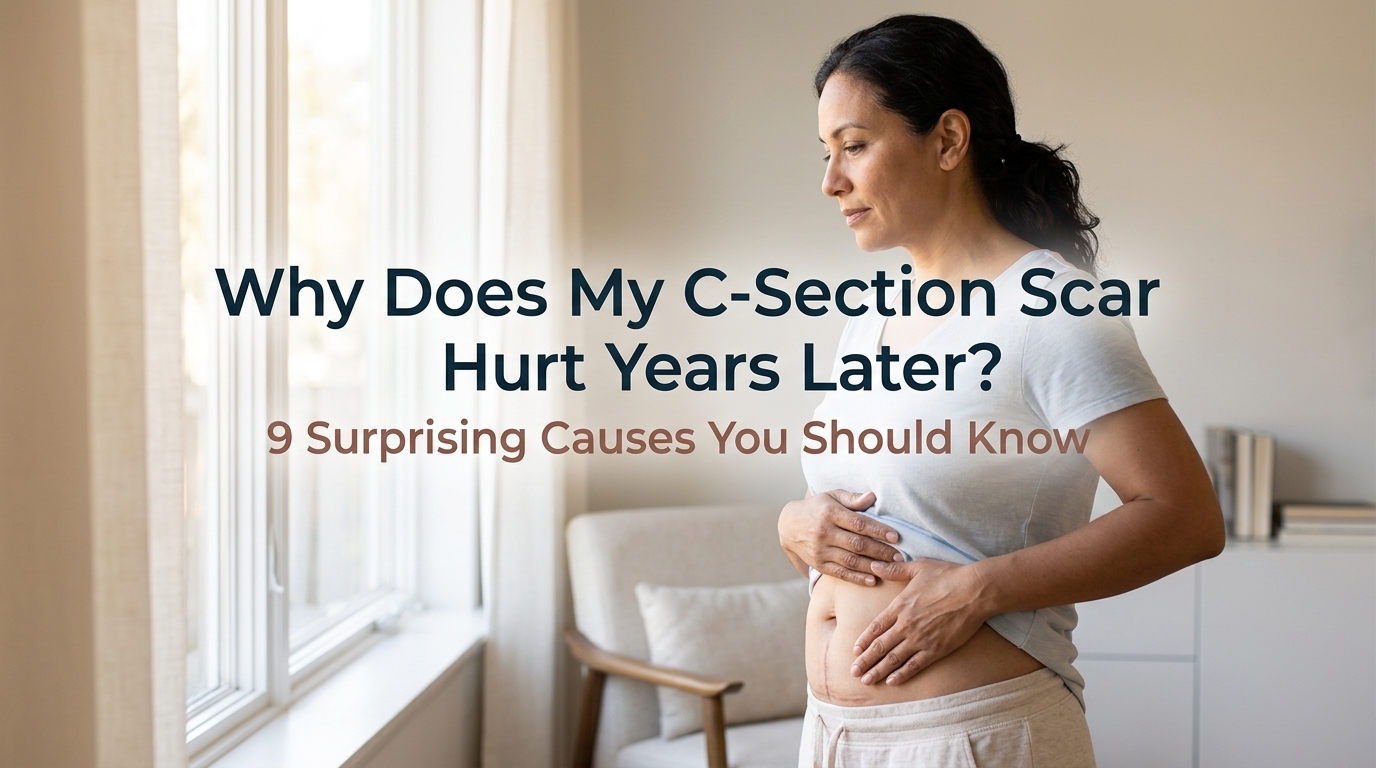
Even with the C-section scar fading until it’s almost unseen, there can be changes beneath it, where the tissue acts unlike the skin surrounding it.If you are wondering, why does my C-section scar hurt years later, the answer is not necessarily that something has gone wrong with the original incision. Nerves can remain sensitive after surgery, scar tissue can restrict movement, and conditions such as abdominal-wall endometriosis can develop at or near a previous surgical site.
There’s the “slight tenderness or tugging” experienced by some, versus the more specific burning, prickling, itching, or even deeper abdominal discomfort. When it develops also is key: “Pain developing just around the time of your period suggests something, while pain during lifting or coughing or pressing on the scar implies something else,” points out Ms. Mikesell.
New and ongoing pain simply shouldn’t be disregarded as simply due to an old surgery.
In fact, studies show it’s well-established that chronic postsurgical pain can persist after a C-section, with reported percentages varying significantly based on the way researchers define the pain, and when they measure it. For instance, A 2025 systematic review and meta-analysis found C-section scar-specific chronic pain at 12 months or later in 8.8% of participants and another recent systematic review estimated that in about 5% of participants by 12 months. Ultimately, therefore, the most useful question isn’t just, “Can an old C-section scar hurt?” It can.
Instead, the more useful question is: “What is responsible for my pain now?”
Why can a healed C-section scar hurt years later?
A cesarean section involves cutting through more layers of tissue than just skin. These include the abdominal wall (connective tissue, muscles and nerves) and deeper pelvic structures, all of which will be healing changed. This is why the surface scar we see might not be the whole story of what has happened.
Some of the long-term discomfort may be part of the process of healing these tissues.
Alternatively the pain may be due to involvement of the nerves around the incision, adhesions further down inside the abdomen, a hernia or an independent problem that occurs to affect the area. It is critical that these issues be distinguished. This is particularly true when pain is the new complaint several years after surgery. “Post-operative pain that develops many years after surgery is not, necessarily, due to the operation.
Other things should be considered before automatically making this assumption.”
1. Nerve-related scar pain
Another possible cause for pain surrounding a scar is changes in sensation. Certain small nerves in abdominal wall tissue may become damaged or disrupted during making the incision of any abdominal surgery, such as on how pain or nerves grow into and during healing or how scar tissue gets formed. In persons, who develop nerve alteration after this, other reported sensations might include such things as electric sensation like pain, sharp prickling pain like and/or some kind of numbness. Other sensation changes include hyper- sensitivity and pain due to gentle brushing like stimulation.
This is often called neuropathic pain.
It may feel very different from the aching associated with an ordinary muscle strain. A person might describe the scar as:
- burning or stinging
- unusually sensitive to clothing
- numb in one area but painful in another
- painful when touched
- associated with brief shooting sensations
The location of the pain can also be informative. For example, if a discrete region of the scar (rather than the whole of the abdomen) hurts, it could suggest local nerve damage.
Chronic postsurgical pain is more complex than “cutting” a nerve. Current models of chronic postsurgical pain propose that explicit nerve damage is not responsible in all cases, and multiple biological and pain mechanisms may be involved.
2. Scar tissue and adhesions
Adhesions Another cause can be adhesions – bands of scar tissue that form within your body after surgery. External scar tissue that you can actually see or feel on the incision you have is not an adhesion – an adhesion occurs internally and makes parts of the body that aren’t supposed to stick together develop an abnormal connection. Pelvis, abdomen, abdominal wall, bowel, uterus, and other tissues can all be affected by adhesions.
This doesn’t mean they always cause problems, or that if adhesions are found, they have been causing all of an individual’s pain problems.
If an adhesion is causing a problem, the pain can often feel deeper than just shallow pain you may experience under your skin scar. Some people will notice a tugging sensation, deep pulling pressure or pain at a certain time of movement. This can be why even someone with an incision scar that looks fine and there is pain located below it. A test can look normal in imaging, a physician will not make assumptions on an adhesion.
3. C-section scar endometriosis
A key condition to recognize is C-section scar endometriosis, which is also known as abdominal-wall scar endometriosis. The definition of endometriosis is the condition in which tissue that is like the tissue lining the inside of the uterus grows outside the uterus. Endometrial-like tissue can be found associated with the surgical scar of a cesarean section scar in certain situations. The Mayo clinic identifies that one such context in which it can develop is after a surgical complication: C-section scar.
The classic clue is pain that becomes worse around menstruation.
A person may notice that the scar:
- hurts before or during a period
- becomes swollen or tender at certain points in the menstrual cycle
- develops a firm lump
- feels increasingly painful over time
- occasionally changes in appearance
In some cases, there can be bleeding or discoloration from a lesion at the scar.
The illness can occur many years after the cesarean section. Case reports have been published showing symptoms in a patient several years after the C-section, even where pain and a mass were noted many years after surgery.
The delay can make diagnosis surprisingly difficult. It is quite understandable for a woman to expect a C-section scar to have healed long ago, when in fact the condition does not relate to ‘normal’ scar healing at all.
Why menstrual timing is such a useful clue
Endometrial tissue is hormonally responsive. Therefore, consistent correlation between scar tenderness and menses is more revealing then the simple declaration “my scar is tender.”
Pain that began 2–3 days premenstrually and continues for the first few days of menses warrants a separate explanation than the patient who began hurting her scar after lifting a heavy object.
A tender mass in the scar that becomes more apparent in menses deserves a gynecologic evaluation discussion.
Literature and case reports have detailed the “cyclic pain and sensitive mass at the c-section scar as classic findings” although not everyone will present in this predictable manner.
4. A C-section scar hernia
Another potential cause of pain at the site of previous abdominal incision is a hernia.
An incisional hernia after C-section occurs when tissue bulges through a weak section of the abdominal wall. The hernia is often felt as a bulge which may become visible when standing, coughing, straining, or lifting. Pain can be made worse with activity or pressure.
A hernia can be considered distinct from normal scar tissue and as such should not be assumed to be part of the scar simply because a bulge can be felt at the scar site. The area should be assessed in standing, cough and position change by a physician. An Ultrasound or CT scan may be needed depending on the physical findings.
5. Muscle, fascia, or abdominal-wall problems
It is also sometimes not the scar itself that is sore.
Muscles and tissues surrounding the abdominal wall can get stretched, or can have long term tension or tightness built into them. Changes in how the abdominal wall is used (perhaps due to movements changes after childbirth, operations, sport, weight loss or gain) can cause irritation.
This type of pain may become more noticeable with:
- bending
- getting out of bed
- lifting
- exercising
- prolonged standing
- certain twisting movements
As mentioned, physical examination is key for differentiate superficial tenderness of scar and pain from abdominal-wall.
Physical treatment may occasionally beneficial especially when muscular tightness, range of motion impairment or pelvic floor dysfunction coexist. Any physical treatments should however be targeted on appropriately diagnosed pain rather than assume that every painful scar can benefit from massage and stretching.
6. A painful or unusually sensitive scar
A year or two after surgery, a scar might continue to be raised, tender, tight, or over-sensitive to touch. The mature scar will never look or feel quite like skin, although it may relax after a while. The skin across the scar may feel tight when the adjacent tissues move, and some individuals even develop keloids or hypertrophic scars (raised scar tissue). The difference between a sensitive (when rubbed) scar and a scar that has become unexpectedly painful after a number of pain-free years can be important: In the former situation, the scar itself is likely the issue, whereas, in the latter case, new symptoms might reflect new processes at play that don’t necessarily reflect “normal” scarring.
7. Pelvic conditions that happen to cause pain near the scar
Although the painful area may be near your C-section scar, it doesn’t necessarily mean that the scar is the pain generator. Endometriosis other than in the pelvic area, ovarian cysts, pelvic inflammatory disease, and urinary or bowel problems, or other gynecologic problems could be generating a lower abdominal or pelvic pain. For example endometriosis can be associated with pelvic pain, painful menses, dyspareunia, bladder pain, bowel pain, and lower back or abdominal pain.
Hence it is more informative to describe all the findings rather than the location of the pain.
Tell your health professional about changes in your menstrual cycle, pelvic pressure, symptoms related to the bowel or urinary system, dyspareunia, unusual bleeding or a detected lump.
8. Infection is less likely years later—but new changes matter
A routine surgical-site infection generally occurs around the period of surgery rather than suddenly appearing many years afterward.
However, a scar that has been dormant and suddenly flares up by turning pink, hot, puffy, more sore with subsequent swelling and/or draining should be assessed.
ACOG recommends contacting your OB GYN for incision pain that gets worse, fever and chills, drainage/leaking, heavy bleeding or other alarming symptoms post surgery.
Years later, those same symptoms don’t necessarily make an old scar “new” and should still be attended to just because the surgery happened ages ago. A new skin infection, cyst, abscess or other medical problem could develop at an old scar.
9. Pain from something unrelated to the C-section
There is another possibility that is easy to overlook: the pain may have nothing to do with the C-section.
Lower abdominal and pelvic pain can arise from many structures and may be related to pelvic health conditions. A person may associate the discomfort with the most obvious landmark—the scar—even when the underlying source is elsewhere.
For example, back problems, abdominal-wall strain, gastrointestinal disorders, urinary conditions, or gynecologic problems can produce pain in approximately the same region.
That is why a diagnosis should be based on the pattern and examination rather than on the scar’s presence alone.
How doctors investigate C-section scar pain years later
The first step is usually to take a detailed medical history.
A clinician may ask when the pain began, whether it has been getting worse, exactly where it is located, and what makes it better or worse. Menstrual timing is particularly important when endometriosis is a possibility.
The physical examination may include looking for:
- a lump or swelling
- tenderness
- changes in skin color
- a hernia or abdominal-wall weakness
- areas of numbness or hypersensitivity
- restricted movement
- deeper abdominal or pelvic tenderness
If a mass or abdominal-wall problem is suspected, ultrasound may provide useful information. For suspected endometriosis or more complicated pelvic disease, MRI may sometimes be used.
Mayo Clinic notes that evaluation for endometriosis can include a pelvic examination and imaging such as ultrasound, while the diagnostic process depends on the symptoms and suspected location of disease.
For scar endometriosis specifically, imaging can help identify a lesion, but tissue examination may ultimately be needed to confirm the diagnosis. Published clinical reports describe diagnosis being confirmed through histopathology after surgical removal.
What should you tell your doctor?
Instead of simply saying, “My C-section scar hurts,” describe the pattern.
For example:
“The scar is usually comfortable, but for the past six months it becomes painful about two days before my period.”
Or:
“The pain is burning and occurs when clothing rubs against one small section of the scar.”
Or:
“There is now a lump beneath the scar that becomes more noticeable when I cough.”
Those details can substantially change the direction of an evaluation.
Keeping a simple pain diary can also help. Record the date, menstrual cycle day, activity, pain location, intensity, and whether swelling or a lump appears.
When should you seek medical attention?
Some slight, temporary discomfort over an old scar might not require urgent medical attention. But new, or constant, worsening or unrelated pain should be investigated. Visit an emergency department right away If you experience a fever; substantial inflammation or redness; drainage; an increasingly larger bulge; major abdominal pain; unending vomiting; a blackout or fainting spells; heavy bleeding; and some other alarming symptoms.
Instant, severe abdominal pain is notable because an existing scar might not be the reason; in fact, something entirely new and much more serious may well be the issue.
It may be prudent to schedule an appointment to discuss the symptoms and ongoing issues with an obstetric-gynecologist, a primary-care clinician or any specialist that would be better equipped to discuss them if there aren’t any emergency situations a physician needs to manage right away.
Can C-section scar pain be treated?
The management will completely depend upon the underlying etiology.
Neuropathic pain may be managed with medications, topical creams, physical therapy, interventional pain procedures targeted at the nerves or referral to a pain physician depending on the severity and the condition itself.
For wall-muscle issue: Physical therapy and treatment strategies using motion are of help.
For hernia: Surgical intervention may be required especially if the hernia is symptomatic, painful, increasing in size.
Scar endometriosis requires a different approach. The hormonal treatment strategies are used in certain type of endometriosis associated pain while surgical removal may be necessary for localized conditions of the scar disease. The Mayo clinic states that management choices will depend on the symptoms, the stage of the disease, plans regarding pregnancy, as well as individual factors.
The main take away point is that there is no ‘standard C-section scar pain treatment’. Correcting the etiology is much more rewarding and helpful than treating symptoms again and again without reaching the cause.
What not to assume about an old C-section scar
One of the most common mistakes is assuming that every sensation around an old incision is simply “normal.”
Another is assuming the opposite—that any pain years later must mean the C-section caused permanent damage.
Neither conclusion is justified without an evaluation.
A scar can remain sensitive because of normal healing changes. But new symptoms can also signal endometriosis, a hernia, abdominal-wall problems, adhesions, or an unrelated medical condition.
Age of the scar may be less than the distribution of the pain. Pain with menstrauion can suggest different diagnoses for the clinicians. Shock, burning or electric sensation suggests different considerations.
A bulge with coughing/straining leads one to another consideration.
Deep pelvic pain with bowel or urinary symptom would be another consideration for this patient.
The bottom line: why does my C-section scar hurt years later?
If you have been asking why does my C-section scar hurt years later, there is no single explanation. Followingcesarean-delivery-surgery-especially a C-delivery thatoccuredyearsago-pain doesn’t automatically disappear; it can flare up or just persist for reasonsincludingnerve-pain, tender scar issue, adhesion pain, a hernia, a tear or muscular orbindvet-issueand an old-stylescaradenocarcinoma(also named scarendoetriosis.” “ The helpful clue to pinpointting the etiology of thepain often is in the characteristics of that pain-Does it cycle with mensestrouation? A new tender lump you can “feels”; Do you have new sensitivity andburning?
Pain with movement; A new lump?
…. But do you write off a scarred old C –andsection and its Pain. Don’t disregard; the symptomsare new, are getting worse, or are intermittent and affect the routineactivities of your life. You want to have a medical diagnosis thatis helpful.
You want onethat can cure your issue.

8. Frequently Asked Questions
1. Is it normal for a C-section scar to hurt years later?
Occasional sensitivity can persist after surgery, and chronic postsurgical pain is recognized after cesarean delivery. However, new or worsening pain years later should not automatically be considered normal. The cause may be nerve-related pain, adhesions, a hernia, scar endometriosis, or another condition.
2. Why does my C-section scar hurt during my period?
Pain that consistently becomes worse before or during menstruation can be a clue to endometriosis, including endometriosis involving the C-section scar. A painful lump or swelling that changes with the menstrual cycle makes this possibility especially important to discuss with a gynecologist.
3. Can scar tissue cause pain years after a C-section?
Yes. Scar tissue can remain sensitive or restrict movement, while internal adhesions can develop after abdominal surgery. However, the presence of scar tissue does not automatically prove that it is responsible for pain.
4. Can a C-section scar develop endometriosis years later?
Yes. Scar endometriosis can present months or years after a cesarean delivery. Symptoms often include cyclic pain and sometimes a tender lump near the incision.
5. Why does my C-section scar burn or feel like an electric shock?
Burning, tingling, shooting, or unusually sensitive pain can occur with nerve-related or neuropathic pain after surgery. A clinician can assess whether the pattern is consistent with nerve involvement or whether another condition better explains the symptoms.
6. Can an old C-section scar develop a hernia?
An incisional hernia can occur at a previous abdominal surgical site. A new bulge that becomes more prominent with coughing, straining, or standing should be evaluated rather than assumed to be ordinary scar tissue.
7. Should I see a doctor for C-section scar pain years later?
Yes, particularly if the pain is new, persistent, worsening, severe, associated with a lump, or connected with menstrual cycles. Urgent evaluation is appropriate for severe sudden pain or concerning symptoms such as fever, significant swelling, drainage, heavy bleeding, or fainting.
Conclusion
If you’re wondering, why does my C-section scar hurt years later, the cause may be something as simple as lingering nerve sensitivity or scar tissue, but persistent or newly developing pain can also be linked to adhesions, a hernia, abdominal-wall problems, or scar endometriosis. When and where the pain occurs-is it worse before your period, with certain motions or when you press the sensitive area?-can be helpful in the diagnosis.
Milder tenderness may be normal from time to time, but severe, new, progressive, or recurrent pain certainly warrants seeing a doctor. Identifying a problem at the origin of pain is a major hurdle to figuring out if you need treatment and for identifying a recent surgical scar for the symptom which is likely unrelated.