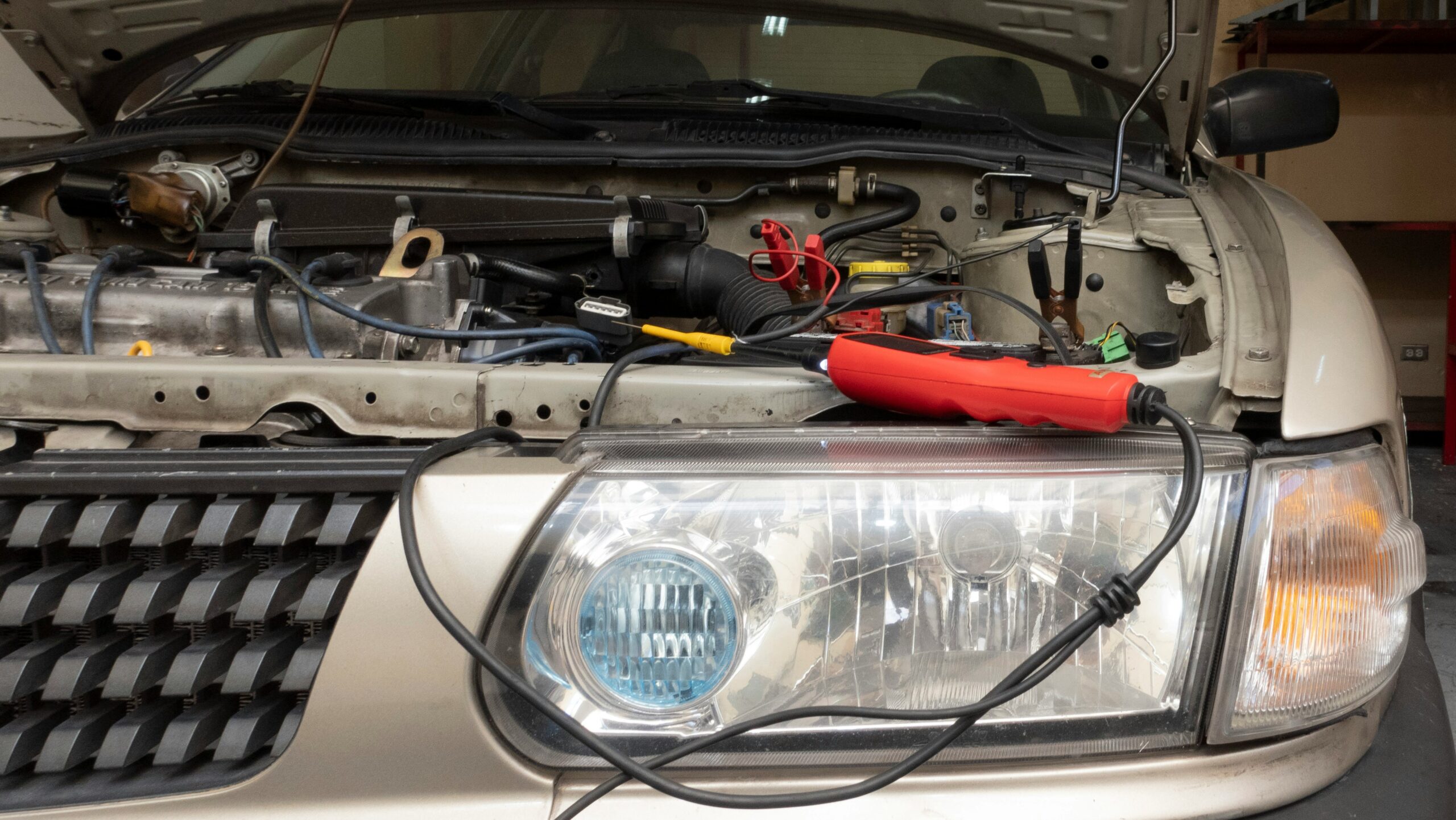
No car battery ever really quits in the best circumstances. The signs often precede death, however, such as when you notice the engine turns over just a little more sluggish than usual, your headlights seem dim while your car is at an idle, and a few days of sitting around might prompt a needed jumper.That is why knowing how to check car battery life before the battery fails can save you from diagnosing a problem in a parking lot or on the side of the road.
What’s not always understood is that you can’t trust just voltage alone, because a battery might appear to be at a healthy voltage yet be unable to supply the current necessary to crank an engine. And sometimes a seemingly weak voltage may indicate a discharged battery rather than a failed one-this is the main reason AAA and battery test specialists talk about both state of charge and battery health. A thorough battery test uses a combination of measurements such as resting voltage, charging system voltage, starting performance, battery condition, battery age and a proper battery load test or electronic battery tester if warranted.
Why Checking a Battery Is More Complicated Than Reading a Voltage
A standard automotive starting battery (also often called a “cranking battery”) is designed to provide lots of electrical current for a brief moment. Battery cold-cranking amps (CCA), an industry benchmark of how a battery’s starting power is measured, is the way of quantifies this capability. Just because a battery is unable to produce strong cranking performance doesn’t mean that its voltage isn’t high enough to make lights and the radio operate.
And this points to one of the most frequent errors people make on their own battery diagnostic journey: just because the test reads twelve volts means it’s okay.
It doesn’t mean anything close to that.
The benefit of measuring a battery’s voltage isn’t about showing a battery is good, it will about showing how full the battery is and understanding basic car battery maintenance. For a standard battery system, this is usually pretty straightforward – 12.6 or above equals 100 percent charged (but may not necessarily indicate an abundant future) and anything below 12 volts is often below fifty percent charged and in serious need of a full recharge (likely on a good smart charger).
As even Interstate Batteries states “A voltmeter used for simple DC testing can indicate whether the battery requires charging; however, it cannot indicate if it will continue to perform properly through another charging cycle.”
How to Check Car Battery Life With a Multimeter
The Digital Multimeter In many respects a digital multimeter is the cheapest and simplest tool to find out status of a classic 12 volt starter battery on your vehicle . You will probably find any of these cheapest Chinese meters from Amazon more then good enough to take an voltage reading of the battery .
When testing first park your car out of the road and make sure you have turned off the engine and all accessories, also you have to ensure the battery terminals are available and visible . When recently you drove your car with that battery let the resting charge settle, as the topcharge can mislead in showing incorrect values with high voltage on the tester.
The meter setting : Switch the multimeter to dc volts. Place the black tip of the lead on to the positive terminal of the battery with the red tip to the negative one… read the result on the lcd display.
As a fully charged classical lead acid battery the voltage at a zero current will mostly be in the 12.6 to 12.8 v range, as the state of charged batteries depends on battery composition , temperature and other testing aspects . Interstate mentions (on its own conditions) a fully discharged state up to the 12,88 v of the resting voltage , clore autom. Mentions 12,6 to 12,8 v of fully charged car batteries depending on its composition .
Although, if the voltage below that is not an indicator that your battery is dead, it may be discharged.
A practical resting-voltage guide
| Approximate resting voltage | General indication |
| 12.6–12.8 V | Fully charged or close to it |
| Around 12.4 V | Partially discharged |
| Around 12.2 V | Significantly discharged |
| Around 12.0 V or lower | Heavily discharged |
These values are approximate rather than universal pass/fail limits. Battery chemistry, temperature, recent charging, and measurement conditions can affect the result.
The important question is what happens after the battery is properly charged and given time to rest.
Don’t Confuse Low Charge With a Bad Battery
Suppose the vehicle had been sitting for several weeks. You test and measure 12.1 volts. You would be in the habit of thinking that the battery is shot.
However, that conclusion would be in error.
A discharged battery may be discharged due to the vehicle not being run,due to accessories being left on, or even due to parasitic draw. If the battery is able to accept a proper charge and hold its normal resting voltage after the charge process is complete, then it may still be usable.
This AAA test result “Good- Recharge” is treated differently from “Replace Battery”, and therefore can help to illustrate why battery condition is different from battery state.
The opposite can be true also.A battery can charge up to a seemingly good voltage, but fail and discharge rapidly, or test fine at rest, and fall down when a heavy starting load is placed on it. This type of situation would lend itself to a more definitive test.
Check the Battery While the Engine Is Running
Your battery test shouldn’t end with the battery. Check out your vehicle’s charging system too.
Turn on your engine and measure the voltage at the battery again. If your car has a working charging system, voltage should be naturally higher than the battery’s resting voltage. Interstate Batteries generally states that a properly functioning car charging system should produce between 13.7 and 14.7 volts when the engine is running, although charging voltage can vary depending on the vehicle and its charging system.
You must also compare the running voltage to your car model’s manufacturer recommendations, which could mean the running voltage could go up to 15.5V on models. If this number consistently comes down too low, it is more possible that a charging system issue caused your battery failure.
A reading that is too low could mean a faulty alternator, wiring or charging connection. Because newer car utilize sophisticated electronical charging systems and they intentionally put out varied alternators outputs, they are going to provide varied alternators outputs, that’s way these kind of numbers for a car need to be interpreted using vehicle car manufacturer’s recommendation & conditions how measurement taken to take the measurement into consider & contrast with vehicle manufacture “recommendation values”. A changing system issue does not mean new battery fixing the vehicle.
Watch What Happens When You Start the Engine
The starter motor’s demands represent the single biggest electrical drain on typical car battery. Thus, cranking character is a good indicator of vehicle’s condition.
For healthy battery, the starter should crank the engine with conviction, even under load. If cranking seems sluggish (especially after a night of sitting), battery is a suspect to investigate.
Listen to the cranking. Slow, reluctant or clicking cranking can often indicate a weak battery, though bad connectors, a poor starter or different malfunction can cause it.
An electronic tester from a professional service will be able to give a better indication of available cranking amps and overall battery status than a mere voltage reading at rest. AAA says there is more value in having it formally tested on the proper electronic equipment.
What a Load Test Actually Tells You
A battery load test asks a more meaningful question than “How much voltage does the battery have?”
Does the battery’s output hold sufficient voltage under heavy electrical load? Traditional load tests put a specific electrical load on a battery for a specific amount of time. It’s a common diagnostic technique; many test tools take that by matching load current to a percentage of the battery’s CCA and then recording the battery’s voltage through the test.
As explained in the testing instructions for carbon-pile equipment from Clore Automotive, for instance, testing half-capacity at the battery’s CCA is recommended for 15 seconds.
But even so, temperature can be an influencing factor. Clore Automotive, for instance, presents charts that recommend different minimum voltage levels for testing at different battery temperatures, showing there’s no simple go-to number across the board. But there’s one more factor that must be kept in mind: state of charge impacts the load test accuracy. For conventional load tests (which, if you’ll recall, are usually “invasive”), batteries often need to be somewhat charged before testing; the directions for most equipment advise against using a discharged battery.
If a battery truly has a discharged state of charge, a charging cycle may need to be run on it prior to performing a traditional load test.

Electronic Battery Testers: A More Complete Picture
Many repair shops use electronic or conductance-based testers rather than relying exclusively on a traditional load tester.
Tests can provide several readings such as voltage, percentage of charge, and potential starting ability. The test result can vary depending on the battery type and testing device, with common results such as “Good,” “Replace,” or “Charge and Retest.” AAA explains that a “Charge and Retest” result generally means the battery’s voltage is too low for an accurate assessment, while a “Replace Battery” result indicates that the battery is likely unable to hold an adequate charge and may be nearing the end of its service life.Electronic battery testers are particularly effective in assessing the new varieties of batteries such as AGM and those for start-stop applications, but they must be set to match the batterytype and a CCArating.
Inspect the Battery Before Testing It Further
Electrical measurements are only part of the diagnosis.
Inspect the battery as well. Overzealous corrosion on the terminals will create excess electrical resistance in addition to the starting issue that is the reason for this article. Furthermore, a loose battery cable connection might be indicative of symptoms mimicking a battery issue or failure.
And have an eye out for physical signs of compromise.
If the case of a battery appears swollen or contains cracks or leaking fluid that you see, charging testing the battery multiple times is not likely to fix your problem. According to AAA cautions that this kind of corrosion can mean the battery contains significant hazards relating to fumes gas and chemistry therefore suggesting replacing it rather than simply boosting it. Never attempt to open sealed a sealed maintenance free battery an AGM battery – these should by no means, be hydrometer’s if one needs to be tested, says the experts at interstateBatteries.com.
Battery Age Still Matters
Where testing provides information about the present state of the battery’s health, the age of the battery does provide helpful information.AAA’s 2026 repair procedures provide information suggesting that auto batteries typically last from three to five years but can be affected more greatly by heat, short drives, onboard electronics, and the quality of battery maintenance.
Age should not necessarily be looked at as a minimum retirement age; for example, a four-year-old battery passing test after test should not automatically be assumed to be failing, and it may be time to address a two-year old battery failing multiple tests or losing its charge routinely much sooner. The test and age should be used in conjunction.
A battery which is several years old, frequently requires a jump, has a difficulty cranking the engine and also is shown as being unhealthy should be a much easier one to give you sufficient reason to replace.
Signs Your Battery May Be Near the End
Sometimes the first clue is not a multimeter at all.
Instead look for a pattern of symptoms and not just a one-off. The typical signs to watch for are slow cranking, several jump starts, funny things happening with the electrics, visible corrosion, a failure to start after sitting up for a while, and battery becoming discharged repeatedly. Repeatedly discharged battery should be properly examined though, because the fault may lie with the alternator or an electrical drain rather than the battery itself, which explains why you are going back through new batteries.
What a Battery Test Cannot Tell You by Itself
No single test answers every battery question.
Resting-voltage tells you charge, but a load test or electronic test gives indications about starting ability and overall battery condition. A charging-system test will tell you if the alternator is recharging the battery as expected.
Unfortunately, even if the battery tests good, it will not be healthy forever.
Diagnosis relies on measurements in context: the age of the battery, driving habits, weather, starting symptoms, charging system conditions and physical appearance of the battery.
Common Mistakes When Testing a Car Battery
One common mistake is doing a test on the battery right after charging it and using the abnormally high voltage reading as proof that it’s an exceptional battery. Surface charge voltage is about as misleading as it gets.
Another mistake is the assumption that 12.6 volts reading means the battery’s in good condition. It indicates a piece of the puzzle not all of it.
Replacement of batteries is a rather common mistake when a person really has a loose terminal, a bad cable, a failing alternator or is experiencing an excessive parasitic drain.
Try to not perform any sort of a destructive test on a battery that’s undercharged. Battery test device producers caution that the state of charge may skew any information generated by load-testing tools.
When a Professional Battery Test Makes More Sense
A homemade multimeter battery test can give you an answer if you’re doing simple troubleshooting, but it does little in others, cases for professional. The full system test is needed where your car battery dies again and again and you’d wonder a perfectly resting voltage means when a car doesn’t “fire up “ and the last but not the least is the life span of your newest battery when it’s gone dead yet again. Professional diagnostic tools combine tests for the charging system, battery and even starter’s behavior.
Combining testing capabilities for a broader picture helps differentiate the battery unable to hold a charge from an alternator unable to charge the car.
It is worth performing tests on modern cars that employ complex systems, such as AGM technology and dual batteries or automatic start/stop functions along with some form of electronic voltage monitoring/control.
How to Decide Whether to Charge, Test Again, or Replace
The decision becomes much clearer when the evidence is considered together.
• If a battery has a low resting voltage but takes a charge and then holds decent voltage, the only requirement might be charging the battery. • If the battery consistently loses charge even with consistent charging and no visible electrical drain, the condition of the battery will probably warrant more rigorous testing. • if a well-charged battery repeatedly fails a load test or electronics test, replacement will be necessary. • If the battery itself tests fine, and the vehicle still doesn’t start or problems Persist then troubleshoot other parts of the electricalsystem such as cables, starter and alternator in lieu ofsimply purchasing another battery
That is the real value of knowing how to check car battery life: the goal is not merely to obtain a number from a multimeter. The goal is to understand what that number means.
Final Takeaway: How to Check Car Battery Life With Confidence
Knowing how to check car battery life is less about finding one magic voltage and more about building a reliable diagnosis. Start with a resting-voltage measurement, consider the battery’s state of charge, inspect the terminals and case, observe starting performance, and check charging voltage with the engine running. If the results remain uncertain, a proper load or electronic battery test can reveal problems that voltage alone cannot.
Crucially, however, don’t assume a depleted battery is a faulty one, and never consider a battery the culprit behind every no-start problem. Weak alternator, faulty cable, poor terminal connection or any other electrical draw can result in eerily similar symptoms.
A few quick, well-spent minutes of testing can do much more than estimate whether your car will start tomorrow morning and help you follow a vehicle inspection checklist. They can help locate the specific component the cause of which is a minor electrical issue before it becomes an inconvenient road obstruction.

FAQs
1. How often should you check a car battery?
There is no universal testing interval for every vehicle. Checking the battery periodically becomes especially useful as it gets older, before extreme weather, or when starting performance changes. AAA recommends regular battery testing as part of vehicle maintenance and highlights increased attention once a battery is several years old.
2. Can a multimeter tell me exactly how much life my battery has left?
No. A multimeter primarily measures voltage. That can help determine the battery’s state of charge, but it cannot precisely predict remaining service life. A load or electronic battery test provides more information about starting capability and battery health.
3. Is 12.6 volts a good car battery reading?
A resting voltage of around 12.6 volts is generally consistent with a fully charged conventional 12-volt lead-acid battery.However, the reading alone does not prove that the battery is healthy or capable of delivering its rated starting power.
4. What voltage should a car battery have while the engine is running?
A conventional charging system commonly produces a voltage higher than the battery’s resting voltage, with roughly 13.7–14.7 volts often cited as a general range. Modern vehicles may use variable charging strategies, so manufacturer-specific specifications are more reliable than a universal number.
5. Does a battery need to be fully charged before a load test?
For traditional invasive load testing, yes, sufficient state of charge is important for an accurate result. The exact requirement depends on the tester and procedure, but manufacturers warn that testing a heavily discharged battery can produce unreliable results.
6. Can a bad alternator make a good battery look dead?
Yes. If the alternator or charging system is not replenishing the battery properly, the battery can become discharged even if the battery itself is still serviceable. Testing both the battery and charging system helps separate these problems.
7. How long does a typical car battery last?
AAA’s 2026 forecast estimates the life of a typical car battery at around three to five years, although the range varies widely depending on driving habits, battery technology, climate and car maintenance.
Conclusion
Knowing how to check car battery life is about more than taking a single voltage reading. A multimeter can give you a useful picture of the battery’s state of charge, but it cannot determine its remaining lifespan by itself. A more reliable assessment combines resting voltage, starting performance, charging-system voltage, battery age, physical condition, and, when needed, a professional load or electronic battery test.
If the battery has been run dead, recharge and try it again before concluding that it’s dead. If it repeatedly drains and can’t make a good crank, or if it performs poorly during a valid battery health test, it might time for a replacement. Don’t forget that a bad alternator, dirty terminal connection, or parasitic drain could give you symptoms that mimic a dead battery.
In most cases, it’s wise to perform a comprehensive diagnostics on your entire starting and charging system rather than basing decisions on a single, limited piece of data.
By performing these few simple tests, you can hopefully catch a weakening battery in time, avoid prematurely replacing it, and ensure you’re less likely to get stuck with a no-start situation unexpectedly.