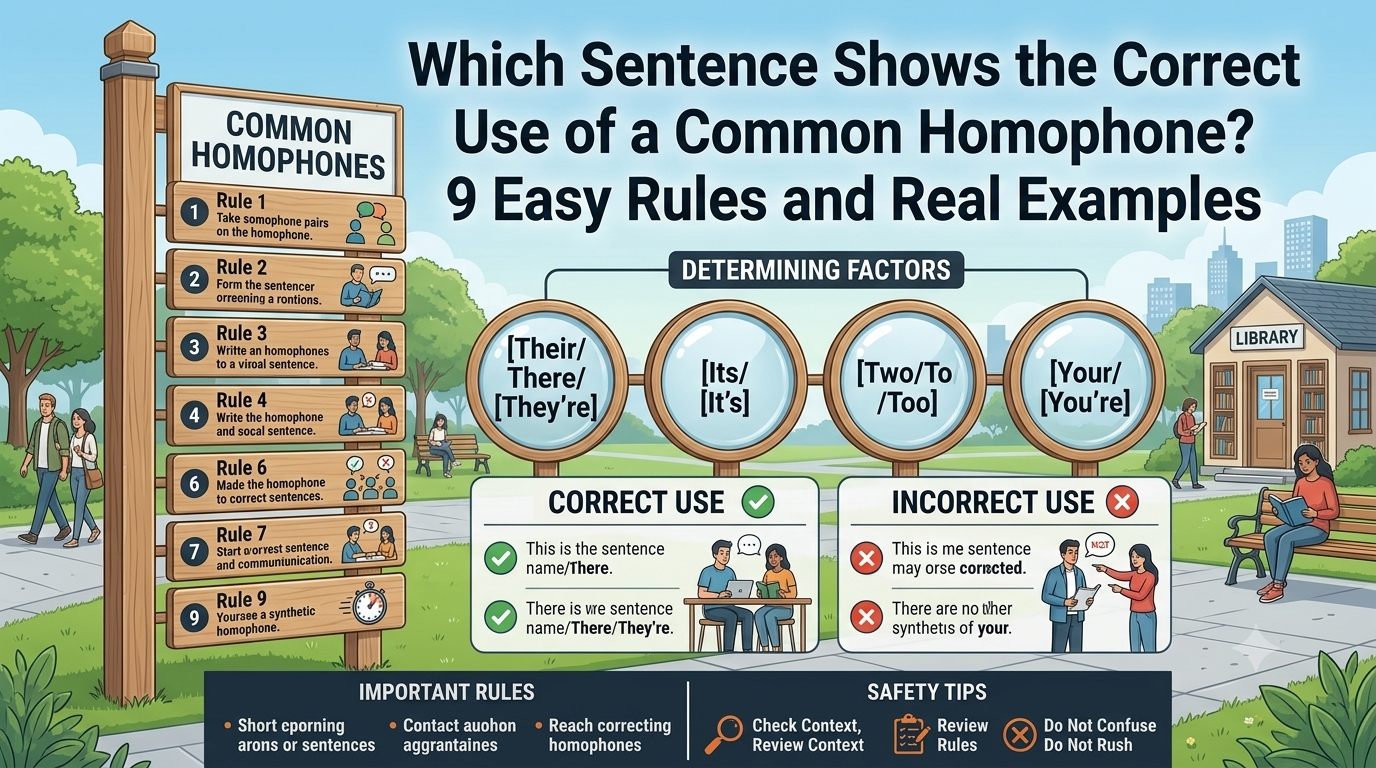
English contains a large number of words that sound the same when spoken but have different meanings. The confusion they cause leads to lots of mistakes in emails and school assignments, as well as errors on social media and even on standardized tests.That is why so many people search which sentence shows the correct use of a common homophone? They are not simply looking for the right answer to one question—they want to understand how to recognize the correct word every time.
Unlike misspelled words, which are easily identified as incorrect, homophone errors can be more challenging to detect since the wrongly used word is spelled correctly. One could think that they have used the word correctly while, in fact, having made a mistake. Recognizing homophone errors helps improve writing and reading skills.
The article discusses the most frequent homophones, addresses the issue of why they are problematic, provides guidance on knowing which word is the right one and explains what professional writers do to avoid such errors.
What Is a Common Homophone?
A homophone is a word that shares the same pronunciation as another word but has a different spelling and meaning.
For example:
- their refers to ownership.
- there refers to a place.
- they’re is the contraction for “they are.”
Although all three words sound similar, you can’t just replace them with each other.
This is why many English learners (and even native Anglophones) make mistakes when using them, especially when learning commonly confused English words with similar sounds or meanings. It always depends on the context in which you’re going to use the word, and not on how it sounds.
Why Homophones Cause So Much Confusion
English has evolved through hundreds of years of development. Some words have been adopted from other languages such as Latin, French, and Germanic, Greek, etc. With the pronunciation changes, different words started to sound similar even though they have different spelling and meaning.
That is why there are sentences that sound correct but contain wrong words.
Consider these two examples:
Correct:
Their dog loves chasing squirrels.
Incorrect:
There dog loves chasing squirrels.
Both versions sound identical when spoken aloud, but only the first is grammatically correct because their indicates possession.
This explains why proofreading based solely on pronunciation rarely catches homophone mistakes.
Which Sentence Shows the Correct Use of a Common Homophone?
The answer depends entirely on whether the selected homophone matches the intended meaning.
For example:
✅ The students left their backpacks in the classroom.
This sentence uses their correctly because the backpacks belong to the students.
Compare it with:
❌ The students left there backpacks in the classroom.
Although “there” sounds the same, it refers to a location rather than ownership, making the sentence incorrect.
Whenever you’re asked which sentence shows the correct use of a common homophone, focus on what the word is supposed to mean instead of how it sounds.
The Most Frequently Confused Homophones
Some homophones appear in writing far more often than others. Learning these pairs greatly reduces everyday grammar mistakes.
Their, There, and They’re
These are among the most commonly tested homophones.
| Word | Meaning | Example |
| Their | Possession | Their books are on the table. |
| There | Location | The books are over there. |
| They’re | They are | They’re studying together. |
A useful memory trick is to expand they’re into they are. If the sentence still makes sense, you’ve chosen the correct word.
Your and You’re
Another frequently confused pair involves possession versus contraction.
Correct examples:
- Your phone is ringing.
- You’re doing an excellent job.
Replacing you’re with you are quickly confirms whether it fits the sentence.
To, Too, and Two
Although identical in pronunciation, these words perform completely different functions.
- To indicates direction or forms part of an infinitive.
- Too means “also” or “excessively.”
- Two represents the number 2.
Examples:
- I want to travel.
- She came too.
- They adopted two kittens.
Understanding the role each word plays makes choosing the correct one much easier.
Its and It’s
This pair often creates confusion because apostrophes usually indicate possession, but not in this case.
- Its shows possession.
- It’s means “it is” or “it has.”
Examples:
- The company changed its policy.
- It’s going to rain today.
If “it is” fits naturally, use it’s. Otherwise, its is probably correct.
How to Identify the Correct Homophone Every Time
Rather than memorizing dozens of word pairs, experienced writers focus on understanding the role each word plays within a sentence. This approach is more reliable because it emphasizes meaning instead of pronunciation.
Start by asking yourself these questions:
- What is the sentence trying to say?
- Is the word showing ownership, location, quantity, or an action?
- Can a contraction be expanded without changing the sentence’s meaning?
- Does the sentence still make sense if you replace the word with its definition?
This habit helps eliminate many common homophone mistakes before they reach the final draft by strengthening English grammar and writing skills.
Practical Examples of Correct and Incorrect Homophone Usage
Looking at examples side by side makes the differences much easier to recognize.
| Correct Sentence | Incorrect Sentence | Why It Matters |
| They’re arriving tomorrow. | Their arriving tomorrow. | “They’re” means “they are.” |
| I left my keys over there. | I left my keys over their. | “There” refers to a place. |
| Your answer is correct. | You’re answer is correct. | “Your” shows possession. |
| It’s raining outside. | Its raining outside. | “It’s” means “it is.” |
| The bird spread its wings. | The bird spread it’s wings. | “Its” shows ownership. |
| She bought two tickets. | She bought too tickets. | “Two” is the number. |
| I want to learn French. | I want too learn French. | “To” introduces the verb. |
| I enjoyed the movie too. | I enjoyed the movie two. | “Too” means also. |
These examples illustrate that choosing the correct homophone depends entirely on the intended meaning rather than pronunciation.
Common Homophone Pairs You Should Know
Many grammar quizzes and standardized tests focus on a relatively small group of frequently confused homophones. Becoming familiar with these pairs can dramatically improve writing accuracy.
Accept vs. Except
- Accept means to receive or agree.
- Except means excluding something.
Correct examples:
- I accept your invitation.
- Everyone attended except Liam.
Principal vs. Principle
- Principal refers to a school leader or something of primary importance.
- Principle means a rule, belief, or fundamental truth.
Examples:
- The principal welcomed new students.
- Honesty is an important principle.
Brake vs. Break
Their identical pronunciation is one reason these words are so often confused.
- Brake helps stop a vehicle.
- Break means to separate, damage, or pause.
Examples:
- Press the brake gently.
- Be careful not to break the glass.
Peace vs. Piece
Although pronounced the same, these words have unrelated meanings.
Examples:
- We hope for lasting peace.
- Would you like another piece of cake?
Weather vs. Whether
- Weather describes atmospheric conditions.
- Whether introduces alternatives or uncertainty.
Examples:
- The weather looks sunny today.
- I don’t know whether they’ll arrive on time.
Why Context Is More Important Than Sound
One reason why homophones are hard is that when you speak English, you don’t hear much that tells you how to spell what you hear. In conversation, context tells you what is meant by homophones, but when you write, you have to choose the right spelling yourself.
Consider this sentence:
I can’t wait to see the sea.
Both “see” and “sea” have the same pronunciation; however, they have different meanings. Although one is a verb and the other is a noun, both contribute to the meaning and clarity of a sentence.
Context clues are used to tell the difference between the two words that sound alike.
Memory Tricks That Help You Choose the Right Word
Many educators recommend simple memory techniques to make homophones easier to remember.
For example:
- Their contains the word heir, reminding you that something belongs to someone.
- There includes the word here, helping you remember it refers to a place.
- They’re contains an apostrophe because it stands for they are.
Similarly:
- Expand you’re into you are. If the sentence still works, you’ve chosen correctly.
- Replace it’s with it is to test whether the contraction is appropriate.
- Remember that too has an extra “o,” which can remind you it means “extra” or “also.”
These simple associations reduce errors without requiring extensive memorization.
Mistakes Students and Writers Make Most Often
Even the most inexperienced writers make homophone errors, but there are still some patterns that occur among these mistakes.
One pattern is that writers tend to rely too much on the spell-check function. Since homophones are all proper words, most spelling tools will not be able to correct them.
Another pattern is that writers tend to overlook the incorrect homophone when proofreading their work.
Many people try to read the text out loud or take a brief break and reread the passage to spot any mistakes. This is because many homophone errors are made on words that are pronounced the same, so a writer may think they wrote the word they intended when they actually wrote a different word.
Lastly, people tend to choose a word based on how it sounds rather than its meaning
Since homophones all sound identical, one must focus on what the word means and what they intend to say rather than how a word is pronounced.
By identifying patterns in homophone errors, one can ensure they minimize the number of mistakes they make when writing.
Professional Editing Strategies to Catch Homophone Errors
Professional proofreaders don’t have much luck as far as the selection of appropriate homophones is concerned – rather, there is a number of special proofing skills helping them to correctly select correct wording. The process of reviewing goes as it goes as follows First and foremost, a proven idea to turn the text in reverse order should come up to your mind – normally it’s quite effective to detect improperly placed words. Also, it may not be superfluous to read the text out in front of the room aloud.
Pay close attention to both the sentence structure and the intended meaning. Understanding the context will help you select the correct word without relying on pronunciation alone.
To the arsenal of many successful proofreaders some peculiar spell-proofing system directed solely to avoid using incorrect homophones – their/there/they’re, its/it’s, you’re/your etc. Applying of this sort of spell-proofing, one consciously tries to detect and correct the using of homophones. Accordingly, there comes higher success rate with the homophones compared with search for all possible errors. All in all, don’t pay excessive attention to built-in grammar or spell checkers – they aren’t so reliable.
Why Learning Homophones Improves Overall Writing
Understanding homophones goes beyond passing grammar quizzes and can improve overall English language skills. It strengthens communication by helping writers express ideas clearly and accurately.
Correct homophone usage improves:
- Academic essays and homework assignments
- Professional emails and workplace communication
- Business reports and proposals
- Social media posts and online discussions
- Blog articles and website content
- Creative writing and storytelling
Another appeal to a piece of text for the reader is the presence of correctly used language. For example the misuse of your vs you’re and your vs you’re can be very obvious, and as a result can lead to a somewhat poor image being placed in the readers head of the author. Similarly good homophone skills are needed for the reader to fully comprehend what the reader is doing as context of the story would be present.
Building Long-Term Confidence with Homophones
As has already been suggested, time has not got anything to do with learning homophones. You have got to put some effort in order to establish a real link between a word and its definition.
When it concerns homophones, in particular, on every single occasion you meet a word, try to find your own sentence which illustrates what it means and how it is supposed to be used. This way you will have more chance to avoid errors in spelling since an individual explanation is more likely to have an impact on your mind than standard words in the dictionary. When it is possible, try reading newspapers or books written by native speakers so as to see how these individuals use the specified wording. At the end, once you have had enough practice, the skill of recognizing the right homophone shall be developed.
Finally, it should be borne in mind that there is a variety of origins of homonyms. For example, sometimes they are same but pronounced in a different way.
Conclusion
Understanding which sentence shows the correct use of a common homophone begins with recognizing that pronunciation alone is never enough to choose the right word. While Homophones are spelled differently from each other, most Homophones are spelled differently and look like what they sound, they usually also have very different spellings and will take part as a given part of speech depending on whichHomophone it is.
Through careful, critical reading and analysis of the intent of your work, and proofreading your own as well as others work can allow you to completely prevent common writing homophones. All writers who work in any profession whether professional, personal use and particularly students writing a Test; have made the acquaintance of ahomophone before.
These most commonly used words are going to appear again whether you’re writing in a classroom setting, in your professional career, or for purely personal use.

Understanding common Homophones.
Frequently Asked Questions
1. What is a common homophone?
Most homophones, that are words which, sound alike but look or mean differently to each other are easy to learn, such as “it’s, its”, “hear, here” and, “their, there and they’re”.
2. Why do people confuse homophones?
Some pairs are commonly used wrongly by people due to similar sounds when said in spoken form. When no attention isPaid To the words, then one would get confused And use it wrong.
3. Which sentence shows the correct use of a common homophone?
A correct example is: “They’re planning to visit their grandparents over there.” Each homophone is used according to its proper meaning and grammatical function.
4.How Do You Remember When to Use “Your” and “You’re”?
Replace you’re with you are. If the sentence still makes sense, you’re is correct. Otherwise, use your to indicate possession.
5. Are homophones always spelled differently?
Most homophones have different spellings, but they share the same pronunciation. Their meanings are determined by context within the sentence.
6. Can grammar checkers detect homophone mistakes?
Some grammar tools identify common homophone errors, but they are not perfect. Careful Similar Sound Words: Similar sounding words are known as homophones. These are words that when pronounced in the same fashion has differences in spelling and meaning. They’re, there and their is one great instance.
proofreading remains the most reliable way to ensure correct usage.
7. Why are homophones important in writing?
If you write, it would definitely enhance your work’s professionalism and credibility by writing to it logically and professionally. If it is used in the “right” situation, readers would be more confident that it comes from a source that knows how to explain your concerns for better clarity.